


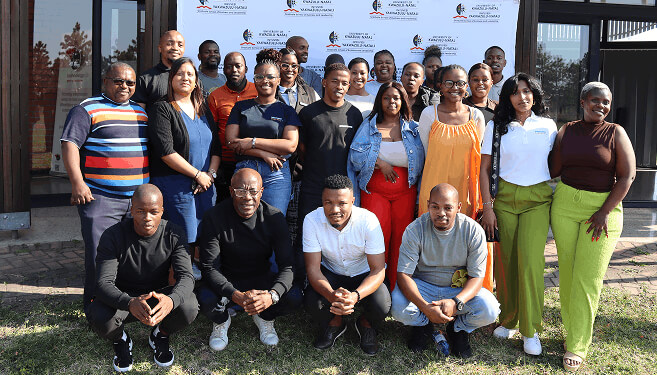
The Regional and Local Economic Development Initiative (RLEDi) in the University of KwaZulu-Natal’s (UKZN) Graduate School of Business and Leadership (GSB&L) implemented its 2026 CREATE (1) Living Lab initiative, which focuses on supporting small businesses to address real community challenges.
The 2026 CREATE Living Lab theme, ‘Developing a Cost-Effective Atmospheric Water Generation System for Community Water Security and Local Economic Development in KwaZulu-Natal’, brought together researchers, industry partners, entrepreneurs and community stakeholders to co-create practical and sustainable innovative solutions.
The initiative, spearheaded by Dr Mlondi Vilakazi, Project Manager, used the case study of Sky Drop, founded by social entrepreneur Ms Nomcebo Nzimakwe, as a platform to explore solutions to water insecurity. Nzimakwe is a graduate of the 2025 KZN Social Economy Development Programme and operates within the water innovation sector through Atmospheric Water Generation (AWG) technology, which produces potable water from atmospheric moisture.
The CREATE Living Lab team first visited the Sky Drop site in Gamalakhe, Port Shepstone, where Nzimakwe showcased the AWG system and shared the operational challenges faced by the business.
Sky Drop identified key barriers including affordability, reliability, adaptability, and sustainability.
In response, the enterprise is developing a solar-powered prepaid AWG prototype designed to improve access to clean drinking water through an off-grid, smart water generation and dispensing system.
Following the site visit, delegates gathered at Ray Nkonyeni Municipality’s Technohub, where Vilakazi presented an overview of the CREATE Living Lab concept and its objective of strengthening innovation through collaboration.
The programme was welcomed by the Honourable Mayor of Ray Nkonyeni Municipality, Cllr Zodwa Mzindla, who emphasised the importance of partnerships that create meaningful community impact.
“Initiatives such as this demonstrate the value of collaboration in finding innovative solutions to challenges faced by our communities, while creating opportunities for sustainable development and local economic growth,” said Mzindla.
The engagement brought together a network of champions, academics, researchers, technical experts and stakeholders, including Innovate Durban, an organisation that supports innovation, entrepreneurship and ecosystem development.
Delegates were divided into specialised groups focusing on key areas required to advance Sky Drop’s prototype and business model, including technical development, commercialisation, business development, partnerships and funding opportunities.
On the second day of the Living Lab, teams presented their findings and proposed solutions aimed at supporting Sky Drop’s growth and increasing the impact of its water innovation solution.
The technical and engineering group explored challenges relating to system optimisation, reliability and scalability, while the commercialisation and business development group focused on strengthening brand visibility, pricing strategies, market positioning and long-term sustainability.
Recommendations included improving digital visibility through social media platforms, conducting competitor and market analysis, exploring larger commercial opportunities, protecting intellectual property, demonstrating profitability at community level and refining the model before scaling into a decentralised water infrastructure solution.
The partnerships and ecosystem group explored opportunities to strengthen collaboration with stakeholders who can provide technical expertise, marketing assistance, strategic guidance, and advice on licensing and funding opportunities.
The engagement concluded with stakeholders making commitments to support Sky Drop, including exploring funding opportunities, assisting with marketing and branding strategies, and providing access to networks that can support the enterprise’s development.
Nzimakwe expressed appreciation for this initiative, thanking the UKZN RLEDi’s and Ray Nkonyeni Municipality for their continued support.
“I am truly grateful for this initiative as it has helped me gain valuable insights, and an opportunity to connect with experts and identify practical solutions that Sky Drop needs in order to help it expand its impact in communities facing water challenges. I plan to implement the advice I received,” she said.
Through the CREATE Living Lab, UKZN GSB&L’s RLED initiative continues to demonstrate its commitment to research-led innovation, community engagement and supporting solutions that contribute to sustainable local economic development in KwaZulu-Natal.
Words: Ayanda Radebe
Photograph: Supplied